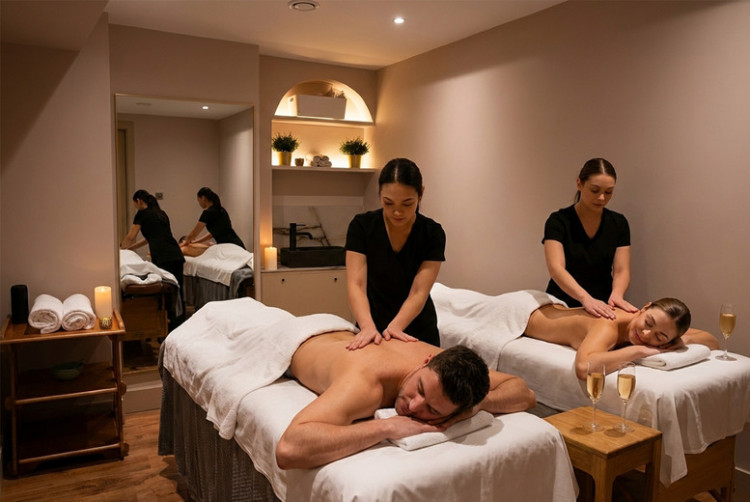


Ditch the ice bath: Kenilworth physio shares what marathon runners should do instead
By James Smith 22nd Apr 2026



With thousands of runners from across Coventry and Warwickshire preparing to take on the London Marathon this weekend, Paul Godfrey, a Chartered Manipulative Physiotherapist at Halo Physiotherapy in Kenilworth, is urging participants to rethink one of the most popular recovery habits.
Godfrey, who has worked with elite athletes through organisations including UK Athletics and the English Institute of Sport, says many runners are unknowingly slowing their recovery by following outdated advice.
"The ice bath industry has done a brilliant job of selling a routine that feels right, but physiologically, it's not always what your body needs," he said.
"After marathon training, inflammation isn't the enemy. It's the repair process. When you suppress it too early, you can actually delay recovery rather than speed it up."
Instead of turning straight to ice baths, Godfrey recommends a simpler and more effective approach: gentle movement, compression and contrast therapy.
"Light walking, wearing compression socks for a few hours, focus on hydration and using contrast baths, one minute hot followed by 30 seconds cool, repeated a few times, will support circulation and help your body do what it's designed to do," he said.
While recovery often gets the spotlight, Godfrey says many marathon injuries actually begin well before race day, with one key thing responsible for the majority of problems he sees.
"The vast majority of running injuries can be traced back to general weakness, in particular lower leg strength," he said. "If I could prescribe one thing to every runner in the training phase before a race, it would be a general strength programme."
Download our Nub News App!
- It’s FREE and available now- Breaking news notifications
- Your Town in Your Pocket


"Everyone starts with a certain level of functional strength, but as the mileage adds up I see people break down as the baseline strength isn't there to cope with the load" says Godfrey.
"Its not too difficult to add some squats, deadlifts and press-ups in three times a week" he added.
Godfrey says foot mechanics and lower limb alignment are another area runners tend to neglect.
"Your feet are the foundation of every step, and inefficient foot function sends load in the wrong direction up the leg.
"Over the tens of thousands of steps in a marathon, that can show up as knee pain, shin splints or hip problems. It's one of the reasons we're expanding into podiatry at Halo, so runners can get their foot function, gait and alignment properly assessed alongside their physio work, rather than treating each issue in isolation."
Another common mistake comes not during the race itself, but in the periods immediately before and after, when runners change their training load too quickly.
"Most injuries happen either in the taper or just after the race," Godfrey explained. "In both cases, it's due to sudden changes in load."
"At this stage, runners should already have reduced their mileage, but it's important not to shut things down completely," he said. "Keep some light intensity in your sessions this week, stay mobile, and avoid any sudden changes."
"After the race, follow a simple rule: allow one easy day for every mile you've run before returning to structured training."
"For a marathon, that means giving your body time to properly recover, rather than rushing straight back into it."
Godfrey, who is also a regular runner himself, said runners should focus on the basics rather than following trends.
"There's a lot of noise around recovery, but the fundamentals still matter most," he said. "Do the basics well, and your body will take care of the rest."
For more information, visit Halo Physiotherapy.
Halo sponsors Kenilworth Nub News.
Without community-minded partners like them, we would not be able to provide clickbait-free news to the people of Kenilworth.
Download our Nub News App:
- It’s FREE and available now
- Breaking news notifications
- Your Town in Your Pocket


Share: